How we farm
The bug inside the mango seed
Every mango season we get a handful of messages that go something like: I cut open the mango and there's a black bug inside the seed. Is this safe? Did the whole box come like this?
It is a fair question and an unsettling thing to find. So I want to write down, honestly, what the bug is, how it ends up there, what it does and doesn't mean about the fruit, and what we do about it on the farm.
What you're actually looking at
The insect is the mango seed weevil — Sternochetus mangiferae, sometimes still listed in older papers under its older name Cryptorhynchus mangiferae. It's a small, dark beetle, around 7–9 mm long as an adult, with a hard, ridged shell and the characteristic snout that gives weevils their name.
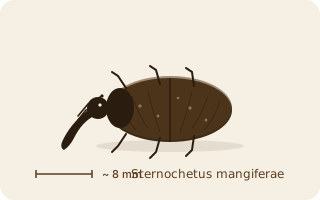
The grub you find inside the stone is its larva. By the time the fruit reaches your kitchen, the adult is usually gone — it has already eaten its way out of the seed and dropped to the soil to overwinter. What's left is sometimes the empty exit tunnel, sometimes a curled-up grub, sometimes a dead adult. Always, by then, the damage to the fruit is done.
How it gets in
The lifecycle runs alongside the mango's own. In late winter, as the trees flower and set fruit, female weevils emerge from the soil where they've been dormant since the previous season. They climb the trunk, find young fruit on the canopy, and lay a single egg on the surface — often near the stem end.
When the egg hatches, the larva tunnels straight through the soft, developing pulp and into the seed. The seed coat hardens around it as the fruit matures, and the larva spends the rest of the season eating the cotyledon — the soft inner part of the stone — and developing inside that protected chamber.
By the time the mango is ripe, the weevil has either already exited (most common) or is still inside, waiting for the fruit to fall or be opened. None of this is visible from outside. There's no entry hole on the skin, no soft spot, no mark. The egg site seals over as the fruit grows.
So why does this happen even on a carefully run farm
Because the weevil is endemic to Indian mango-growing regions and there's no way to fully eliminate it from a working orchard. It overwinters in the soil under the trees, in cracks in the bark, and in dropped fruit from the previous season. Even with good sanitation, a small percentage of fruit gets hit each year.
The infestation rate varies a lot — by region, by variety, by season, by how clean the previous year's harvest was. In heavy years, infested fruit can run into double-digit percentages in a poorly managed orchard. In a well-managed one, it tends to sit at 1–3%, often lower for Alphonso, which has some natural resistance compared to a few local cultivars.
A few weevil-hit fruits in a box from a small farm is normal. A box where most fruits are hit is not.
Is the mango safe to eat?
Yes, with one caveat.
The weevil doesn't carry pathogens that affect humans. The pulp around the seed isn't toxic. The grub doesn't move through the flesh — it tunnels in from the surface as a tiny larva and then stays in the seed for the rest of its development. So the flesh you'd normally eat is, in almost every case, untouched.
The caveat is the section of pulp closest to the seed. Sometimes that area is darkened or fermented — partly from the weevil's exit tunnel, partly from the natural oxidation that follows. If the pulp near the stone looks off-colour, smells fermented, or has visible tunnelling, cut that part away. The rest of the fruit — the cheeks, the flesh further out — is fine.
If the whole fruit smells fermented or alcoholic when you open it, that's a different problem (advanced over-ripening, sometimes accelerated by the weevil damage) and we'd rather you don't eat it. Send us a photo and we'll replace it.
What we do on the farm
The two effective controls for the weevil are timing and sanitation. We don't use systemic chemical pesticides on the fruit.
- Pre-flowering bark scrape: In January and February, we go through the orchard and physically remove loose bark and cobwebs from the trunk and main branches. This is where adult weevils shelter between seasons. Less shelter, fewer adults reaching the canopy.
- Fallen-fruit collection through the season: Every dropped or damaged fruit gets picked up and disposed of away from the orchard. Leaving them on the ground is a free incubator for the next generation.
- Deep ploughing at the end of the season: After harvest, the soil under each tree is turned over. The overwintering adults that have dropped into the soil get exposed to sun, birds, and ants — most of them don't make it through.
- Neem-based sprays around fruit set: Neem oil and neem-cake extracts disrupt egg-laying without being a systemic chemical inside the fruit. This is the standard practice on organic and low-input mango farms in Maharashtra.
These bring the rate down. They don't bring it to zero. Anyone who tells you their fruit is guaranteed weevil-free is either using fumigation chambers, exporting through hot-water-treated channels, or — most commonly — just hoping.
A note on exports
The mango seed weevil is a quarantine pest. Several countries — the United States, Japan, Australia, and parts of the EU — restrict mango imports from India unless the fruit has been treated. The accepted treatments are hot-water immersion (around 48°C for 60 minutes) or irradiation, both of which kill the larva inside the seed. APEDA-registered packhouses handle this for the export trade.
We don't run those treatments. They're capital-heavy, regulated, and primarily exist to satisfy import-country inspection, not to make the fruit safer for an Indian customer. For domestic sale, the FSSAI doesn't require them.
What to do if you find one
Cut around the seed. Check the flesh near the stone for the off-colour zone and trim that away. Eat the rest of the fruit. If the pulp looks fine, the fruit is fine.
If you find weevil damage in more than one or two mangoes from a box, message us with a photo and the order number. That's outside our normal range and we'll replace it — or refund that portion of the order — without asking you to ship the box back.
A small farm can't promise perfection. What we can promise is that we're not running away from the question, and we're telling you the actual answer instead of the polished one.
If you want to read more about how we run the orchard, the post on why your Magnolia mangoes arrive green covers the harvest and ripening side.